Thursday, 19 January 2017

Copyright- Did you make it or take it?

I have never been the most digitally literate person and for the longest time I didn't realize that posting other people's photos, videos, or other forms of media was illegal! I always knew that I had to cite authors of books and articles I had chose to use as a support in my papers but using anything that isn't yours to enhance your own work is stealing!! I would say the most useful tip I took away from this is always cite everything. Even if you are unsure about whether you should cite a piece of information do it anyway because it is better to be safe than sorry. I also learned that you should copyright and cite your own work because people may be inclined to take some of your work as well!
There are different kinds of copyright that you can consider when creating a piece of work. For example, if you create a picture and only want people to view it but not download it or edit it, you can have an all rights reserved creative commons. If you would like to share your work with the public and have people build on your ideas, you can have a some rights reserved creative common. You can then decide who can access your work and in what ways.
Overall, it is important to get students thinking about copyright from an early age if you incorporate digital literacy into the classroom. Don't just stop at having students create a works cited page! Have students investigate different kinds of copyright, where they can find copy right and most importantly why copyright is necessary to be digitally literate.

Riberio (2008, June 30) TPCK Re-visioned [Online Image]. Retrieved  from https://www.flickr.com/photos/lupuca/8720604364


Plougmann (2011, January 20) TPCK Re-visioned [Online Image]. Retrieved  from https://www.flickr.com/photos/criminalintent/5403052781/in/photolist-9es4mr-pRr7ZD-8vBVVr-8vEXcj-5k2wrs-4JX9-8Jw9LH-9ayqsd-e2QMS5-o3wN4Z-3mrXAe-28rtGN-5b495D-e2QMHQ-8vEXjo-8vBVTe-8vBWaH-8vEXd9-e3Zz1-fvT5PN-8vEXtU-5guc28-8vEXmG-bFrCvg-68mS5h-CH3be-8vEXbY-bqVQtj-8vEXpw-dJ1HaZ-6wnx18-8vBVYn-8GmvbX-eenL8S-62Y6XP-A8zQK-8vBVWt-dJ79TA-8vBW9D-dJ1Hwn-62Yv2h-hcbzps-8uVpXv-8uVTTM-8vEXvJ-8mr6gF-6VvuFx-6T2Wt9-bFmvU4-fefJT


Friday, 13 January 2017

Welcome Back!

Hello everyone, it has been a long time since my last post because school has just been so busy! I  realized that I started this blog without giving a lot of information about myself! My name is Vanessa Kiedrowski and I am in the concurrent education at Brock University with a focus in the primary/junior stream. I have always loved young children because I feel they have so much curiosity and passion for the world around them. However, I just finished up a junior placement at my school and I enjoyed the potential of the older students too, so I will most likely go back and get my intermediate qualifications. I really feel that I have chosen a career path that I enjoy and am excited about. I have always loved making a difference when I can and over my placement I realized how much I could change peoples lives just by coming to work every day. I look forward to posting about my experiences and hope you can relate and learn from my experiences :)

Wednesday, 16 March 2016

Teacher Activists

As a future teacher and someone who has worked with children the majority of my life, I am invested in providing the best opportunities for them and giving them all an equal chance to be successful. As optimistic as I may be about this topic, there will not be equal opportunities for all the students I encounter. Racism, sexism, ableism and many other structural oppressions are present in the daily lives of our students, especially in the education system. Schools often try to combat this by enforcing a multicultural education where diversity is celebrated but it is often in a tokenistic form (L. Lane, personal communications, February 24, 2016). Many programs do not acknowledge the structural systems that have kept different groups of people oppressed or how one is supposed to acknowledge their own position in the world. That is why I think it is of key importance that before a teacher begins to tackle large problems such as this, they begin by understanding their own privileges and how to address oppression in the classroom.

Teachers must first begin by unpacking their own place in society in relation to their privileges. Social inequalities work at a structural and institutional level in that it has been normalized to the point that it is difficult to detect and address. Therefore, many people reproduce inequalities without even being aware of it. I believe that one of the best ways to better understand ones position is to try things that go out of one’s comfort zone. For example, two years ago I went to Namibia and volunteered in a school for a month. Being immersed in another culture and meeting people that were drastically different then me brought me out of my middle class westernized “bubble” that I had been living in. Now, I understand that traveling halfway across the world is not practical but joining different clubs, meeting new people, or even reading or watching material that challenges your thinking can help to create a self-aware teacher. What arises from a teacher who is aware of their own privilege and the overall structure of society is a person who is empathetic, compassionate, and motivated to create change. Drake, Reid, and Kolohon  (2014) found that teachers that are facilitators are not as effective as teachers who are activists. These teachers are able to facilitate deep learning outcomes, create interesting learning activities that challenge student thinking, and recognize and attend to the “Be” of learning (Drake, Reid, & Kolohon, 2014).

Retrieved from http://pep-teacherleadership.blogspot.ca/2013/03/as-teacher-leaders-we-should.html

Teachers that are self-reflective and activist oriented are better able to implement 21st century literacies into their classroom because they understand the importance of the skills they provide. One of the best ways they can help students is by facilitating critical thinking opportunities. The 21st century society that we live in requires people to be critical literate and able to challenge current social paradigms to be a contributing member of society (L. Lane, personal communications, January 6, 2016). Teachers who are empathetic and compassionate are open to the difficult discussions that come with topics such as mental health, multiculturalism, and moral literacy and this helps students facilitate their own learning. For instance, if a child mentions social differences, do not criticize or discourage them for their observations. Rather talk to them about their observations and answer any questions they have (Plous, 2016). Being open to children’s ideas and observations tells them that they have a safe space to think about difficult topics and have discussions that are uncomfortable. When teachers become activists instead of just facilitators, they create an environment that is conducive for 21st century literacies. 


In case you are further interested in the topic of activism and social justice for teachers, here is a tedtalk by Artika Tyner who is an educator and lawyer that encourages leadership advocacy and social justice education in our schools. The systems of oppression trickle down to effect every generation of people and it can often prevent children from making a difference (e.g. black boys from low SES areas often fall behind in school because they do not have access to preschool learning opportunities). It's the teachers job to be an activist and provide learning opportunities for students that fosters their leadership and activism as well. 


References

Drake, S. M., Reid, J. L. & Kolohon, W. (2014). Interweaving curriculum and assessment: Engaging 21st Century Learners. Toronto, ON: Oxford University Press

Plous, S. (2016). Tips for Elementary School Teachers. Understanding Prejudice. Retrieved from http://www.understandingprejudice.org/teach/elemtips.htm


Wednesday, 24 February 2016

Hidden Curriculum, Curriculum as Lived, and Global Literacy

Through the first 6 weeks of EDUC 4P27 we have explored 21st century literacies and their importance in modern day education. After exploring these literacies it is clear that they provide students with essential skills to be productive members of society including things such as critical thinking, compassion, and perspective taking. My group completed an in depth analysis of global literacy and it made me think a lot about how it connects to other aspects of curriculum, specifically hidden curriculum and curriculum as lived.
            Hidden curriculum consist of ideological assumptions in the classroom that do not appear in the planning portion of curriculum but do present themselves in curriculum that is taught (L. Lane, personal communications, January 27, 2016). The knowledge we teach children is not neutral and what we learn and don’t learn are important indicators of values (L. Lane, personal communications, January 27, 2016). For example, in history classes when students learn about the conquest of North America they learn about it from the perspective of white colonialists and not the indigenous populations that lived there originally. Aspects of hidden curriculum often come into conflict with how students experience curriculum. Students experience curriculum through their beliefs, attitudes, and values which are influenced by race, gender, socio economic status and many other categories. As a result, many students do not connect with curriculum because they do not fit into the bracket of white middle class experiences. After some reflection I believe the 21st century literacies help to eliminate some aspects of the hidden curriculum while also creating better experiences with curriculum and learning for all students
            Global Education is important because it allows students to develop a global identity rather than a national identity which helps create better connections amoung people (Neins & Reilly, 2012). Student’s often overlook perspectives they do not understand unless they are given the opportunity to learn. Reading books from around the world, learning about new cultures in units, and learning about different histories allows students to better understand the differences around them, but also the similarities amoung us. Racism, sexism, and other “isms” happen when people are fearful of things they don’t understand but when they are given the opportunity to learn they will be more compassionate and understanding of people that are different from them. When you can understand new perspectives you realize the knowledge you receive is often from one perspective and it is my belief that through global education students will begin to question the curriculum and knowledge that is deemed important. Furthermore, educators need to appreciate the richness of opportunities that can bring students beyond the classroom and into the global community (Lock, 2015). For instance, educators may set up a global classroom where they skype or interact with schools all over the world to learn about aspects of their culture and heritage. Opportunities improve curriculum as lived because students are able to get a better understanding of their community and the greater world around them. Beliefs, values and attitudes are influenced by the experiences students have and when they are given real opportunities to make connections with the greater world they will feel like they are part of the school community. It is the hope that global and other 21st century literacies will improve education for all students J
References
Lock, J. V. (2014). Designing learning to engage students in the global classroom. Technology,

Pedagogy and Education, 24(2), 137-153. doi:10.1080/1475939x.2014.946957
           
Niens, U., & Reilly, J. (2012). Education for global citizenship in a divided society? Young

people's views and experiences. Comparative Education, 48(1), 103-118 doi:

10.1080/03050068.2011.637766


Wednesday, 13 January 2016

Definition of Literacy


After the first lecture I really found myself thinking a lot about what literacy means in education as well as how the definition has changed over the years. As we discussed in lecture, literacy is more than decoding words on a page, it is also about creating social meanings that vary across contexts. This point really stuck with me because it made me think about previous misconceptions I’ve had about what literacy can be. As long as I can remember literacy has meant having the ability to read and write. I would read the books my teachers told me to read, I’d write essays on topics I was told was important, and I even dedicated long periods of time to learning proper grammar and spelling. So while all these skills are important, sometimes I felt like I didn’t take away information that I felt was important to my life. After thinking about the ideas of critical literacy, environmental literacy, financial literacy, and many other types of 21st century literacies I realized that my definition of literacy was outdated. Literacy in my eyes was a skill that everyone needed to learn to be successful in school and the greater world, but literacy is also knowledge, and knowledge is power. The knowledge that 21st century literacies create allow for people to think about the world in deep critical ways and help form possible solutions for problems that influence our world today. 

       Retrieved from: https://sites.google.com/a/mail.csuchico.edu/21st-century-literacy/
21st century literacies also allow for the development of 21st century skills such as critical thinking and innovation which are needed to be successful in the modern world. I believe the school systems in North America tend to function on an assembly line mentality where all children are taught skills such as memorization or repetition so they can spit out answers on a test but don’t learn any valuable life skills. Children are falling through the cracks because repetition and memorization are not skills that allow for good learning and growth experiences in the school system, setting them up for failure when they leave school. I think the most difficult part about this new definition of 21st century literacy skills is that sometimes it feels like trying to fit a round peg into a square hole. As said before, the school system has a big focus on standardized testing and scores that determine whether children are learning well or not. Unfortunately topics such as critical literacy and environmental literacy are not so easily assessed under standardized testing. I wonder how can 21st century skills be implemented into a 19th century school system? How can teachers change their practices to fit in new ideas? And what does that mean for student teachers like myself? I have been learning more and more about 21st century skills and I wonder how the new generation of teachers can change the fabric of the education system? Regardless, I’m excited to see where this new literacy definition takes me :)

Wednesday, 4 November 2015

Transdisciplinary Learning

As a future teacher I am constantly thinking about the best ways to structure my curriculum to provide the best opportunities for my students. Interdisciplinary curriculum is becoming more and more relevant in the 21st century learning styles and is a style of teaching that I find very interesting. Interdisciplinary curriculum integrates concepts from different disciplines to make a synthesized whole in which many areas of study are considered (Drake, Reid, & Kolohon, 2014). There are several ways to do this but one of the best ways is through transdisciplinary curriculum. Transdisciplinary curriculum means going beyond the curriculum and planning with student interests and real world contexts rather than curriculum outcomes (Drake et al., 2014). Once a relevant theme is established teacher and students work together to decide what curriculum expectations fit their theme best. Since it is a real world context, many subjects are easily incorporated because a variety of ideas and skills are being implemented (Drake et al., 2014). Transdisciplinary curriculums include topics such as world hunger, gender inequality, and many other global issues. For example a question that could guide a transdisciplinary curriculum could be “why do some people in our community not have enough food? How can we change this?”. I wish that I had received this kind of education when I was in school. I feel like many teachers use the curriculum as the almighty guide for lessons and student expectations when sometimes the material is not relevant to the student’s lives. When teachers ask students questions like “what concerns you about yourself and the world around you?” they will be surprised by the immense awareness and knowledge students have about the world. Children are not little machines that you deposit information into. They think, have ideas and most of all care about the world around them and are interested in making change.

For Transdisciplinary curriculum a big idea acts as the overarching theme that leads the inquiry process
Retrieved from http://www.greenwichschools.org/page.cfm?p=6697
            To keep things in line with curriculum development, transdisciplinary curriculums have a very distinct set of know, do and be expectations. Learning to know involves making connections, adapting to changes and knowing how to learn new material. Learning to do involves performance tasks that demonstrate the ability to apply knowledge in a creative manner (Transdisciplinary Learning, 2006). Finally learning to be involves making connections on a local and global scale as well as being on a life-long journey of self-discovery (Transdisciplinary Learning, 2006). I thought I should include this information because it exhibits how possible a transdisciplinary curriculum is to implement. It seems a major risk to leave students to decide what the unit of study should be but through this KDB it is clear this curriculum is designed to implement many valuable skills that can used in the future.
            A great way implement a transdisciplinary curriculum is through project-based learning. In this, students tackle a local problem in the community with the guidance of their teachers (Drake & Burns, 2004). Teachers and students select a topic of study based on student interests, curriculum and local resources as a first step. Then the teacher works with the students to determine what they already know about the problem and help them generate questions and resources to tackle the problem. Finally, students share their work in a culminating activity where they share their results with the class and discuss strategies (Drake & Burns, 2004). Project-based learning has been proven to be extremely effective in that students are more attentive, ask open ended questions, make connections between curriculum and real-world events, and are generally more excited about school and the material that is being covered. I think in my future classroom I will have project-based learning activities in my classroom as it will help me have a transdisciplinary classroom. Using project based learning to help them environment would be useful in the Canadian context. Canada is known for its environmental beauty but pollution is slowly destroying it. As a project-based learning activity students could visit a local pond, forest, lake etc. and determine how they could use local resource to clean it up. Students would be making connections with the community and the real world through this form of curriculum which is knowledge that they will hold onto for a life time. I hope that this is a form of learning that other educators will use in the future because it’s really valuable J


If you want to see a good example of transdisciplinary curriculum watch this video! It's really cool to see all these ideas come together in a real classroom!


References
Transdisciplinary Learning. (2006). Retrieved November 4, 2015 from: http://www.greenwichschools.org/page.cfm?p=6697

Drake, S., & Burs, R. (2004). What is Integrated Curriculum? In Meeting standards through integrated curriculum. Alexandria, Va.: Association for Supervision and Curriculum Development.


Drake, S. M., Reid, J. L., & Kolohon, W. (2014). Interweaving Curriculum and Classroom Assessment: Engaging the 21st Century Learner. Don Mills, ON: Oxford University Press.

Tuesday, 6 October 2015

Learning Goals and Success Criteria

Assessment is a key component for the school system. How would we know if students were learning anything otherwise? Assessment plays a critical role in teaching and learning and should have the goal of developing independent, autonomous, and confident learners (Growing Success, 2010). Unfortunately assessment in most schools has been focused on assessment of learning. This type of assessment only measures student’s performance after it has happened and often compares to other children’s work. This can be detrimental because it doesn’t allow for opportunities to be independent and improve learning. This is why schools are beginning to focus on assessment for learning and assessment as learning. Assessment for learning involves finding evidence for use by learners and their teachers to decide where the learners are in their learning, where they need to go, and how best to get there (Growing Success, 2010). Assessment as learning allows students to foster their capacity over time to be their own best assessors but teachers start by modelling opportunities for students to assess themselves (Growing Success, 2010). These last two forms of assessment are much more beneficial because they allow students to guide their own learning and have some say in the process. A key part of this process is creating learning goals and success criteria in the classroom for everyone to follow.

Retrieved from: http://blackdeer.edublogs.org/2012/11/05/learning-goals-and-success-criteria/

     Learning goals and success criteria go together like peanut butter and jelly so they're essential to each other. Learning goals are short statements that address the KDB of the lesson or unit of study (Drake, Reid, and Kolohon, 2014). A learning goal should address the simple question “what are we learning?” and derive from curriculum expectations. However, they are not simply copy and pasted statements but rather thoughtful statements that divide the unit into learnable chunks where each child can reach the goal at their own pace. Success criteria are the skills needed to complete the learning goal and answer the question “what am I looking for?” (Drake et al., 2014). So for example, a learning goal could be “learning to write a scary short story” and the success criteria could be things like “having cliff hangers, using scary verbs and adjectives, having characters, etc.” To avoid any power imbalances between teacher and student (which is usually avoided through assessment of learning and assessment as learning), the learning the goals and criteria need to be written in student friendly language and make learning attainable and reasonable (Drake et al., 2014). Students can take charge of their own learning by offering ideas of what they deem successful, collaborating with peers and teachers to form a plan, and have the ability to change the criteria as the unit progresses (Drake et al., 2014). The learning goals and success criteria are on a kind of continuum where knowledge is co-constructed by teachers and students and eventually leads to students creating individual goal setting (Drake et al., 2014). This way students are making real connections with what they are learning and  can understand the assessment process. Often what happens in schools is that students don’t know how to be successful because they are not included in the discussion of how to assess. When students are involved in the process they are more likely to strive for success because it is partly based on what they think success is (which is a relative term anyway right?).

Retrieved from: http://www.bestcollegesonline.com/blog/2012/03/28/5-simple-ways-adjuncts-can-help-each-other/


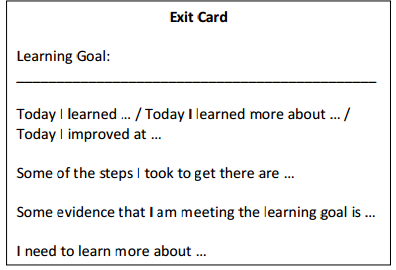
     A great way to assess progress in relation to the learning goal is through exit cards. When students have a clear understanding of what they are supposed to learn they are able to track their progress toward achieving the goal (Learning Goals & Success Criteria, 2010). By asking students to submit exit cards they are able to reflect on the progress they have made towards their goals and what they can do to continue on the right path (Learning Goals & Success Criteria, 2010). I would personally use this kind of assessment in my classroom because it is a great way to track their learning. Sometimes when setting goals people forget things along the way or their thoughts change on what their goal should be. By creating exit cards it can help students further internalize and personalize their learning goal, making it more likely to be achieved (Learning Goals & Success Criteria, 2010).
In my own personal experience I have rarely been in a classroom that allows students to be part of the assessment process. It was always about having the teachers teach at us which left us excluded in this part of education. I think learning goals, success criteria and the co-construction that goes along with it allows for great repoire between teachers and students. Furthermore, it gives students a sense of empowerment and independence in their learning experience which is something they rarely get but it can affect how seriously they take their education. Finally, the feedback would be much accurate through this method because the teacher and the student are on the same page about what success means and how they can accomplish it.

       Retrieved from:http://www.edugains.ca/resourcesAER/VideoLibrary/LearningGoalsSuccessCriteria/LearningGoalsSuccessCriteriaViewingGuide2011.pdf

Finally, if you’re ever unsure about when to implement this kind of assessment, just ask yourself these three questions (Davis & Herbst, 2013):

1.      When could I co-construct criteria? How can I use examples to support an understanding of success so the criteria are better?

2.      How can I involve students in using criteria as a guide for self-assessment, peer assessment, and as a way to monitor the progress of their learning?

3.      How can learners show proof of learning from the co-constructed criteria?


If you would like to understand more about learning goals and success criteria, check this out!

References

Davis, A., & Herbst, S. (2013). Co-constructing success criteria: Assessment in the service of


Drake, S. M., Reid, J. L., & Kolohon, W. (2014). Interweaving Curriculum and Classroom
Assessment: Engaging the 21st Century Learner. Don Mills, ON: Oxford University
Press.

Exit Card (2010). Retrieved


/LearningGoalsSuccessCriteriaViewingGuide2011.pdf

GROWING SUCCESS: Assessment, Evaluation, and Reporting in Ontario Schools. First
           
 Edition, Covering Grades 1–12, 2010. Retrieved from

http://www.edu.gov.on.ca/eng/policyfunding/growSuccess.pdf

Helping Hands (2012). Retrieved  from: http://www.bestcollegesonline.com/blog/2012/03/28/5-

simple-ways-adjuncts-can-help-each-other/

Learning Goals & Success Criteria (2010) Assessment for learning video series. Retrieved from


rningGoalsSuccessCriteriaViewingGuide2011.pdf

Success Criteria (2012). Retrieved from http://blackdeer.edublogs.org/2012/11/05/learning-

goals-and-success-criteria/